
Saramsh Gautam on Aug 17, 2026
Reading Time: 8 Min
Rising talent costs in the US are driving more companies to build offshore engineering teams. Recent industry data shows over 20,000 PE-backed portfolio companies successfully moving to offshore development centers (ODCs), with Nepal emerging as a strong option that balances quality, affordability, and collaboration.
Success takes more than hiring a few developers. The first 90 days are critical—they determine whether your offshore team becomes a strategic asset or an ongoing challenge.
In this period, you define goals, hire skilled engineers, set up tools, onboard the team, and establish clear communication. With strong planning and cultural alignment, companies can build a productive team in Nepal and ship features within 90 days.
This guide walks you through exactly what to expect.
Why Choose Nepal as Your Next Offshore IT Hub
Nepal has not yet experienced the same level of IT market saturation as India. This creates a clear advantage: a strong supply of skilled professionals and less competition for talent, making it an attractive location to build an Offshore Development Center.
1. Global Talent at Affordable Rates
When factoring in salaries, hiring, management, retention, and benefits, engineers in Nepal typically cost about 1.5 times less than their counterparts in India. Check out this ODCs comparison table that breaks down talent, team ownership, and other relevant costs.
Nepal produces around 25,000 IT graduates each year, many specializing in web development, mobile apps, cloud infrastructure, and data engineering. This steadily growing talent pool gives companies reliable access to skilled engineers without the intense competition seen in more saturated markets.
2. Faster Hiring Without Compromising Quality
Finding experienced developers in the U.S. can take weeks, and onboarding can stretch to months.
Instead of starting from scratch, Nepal ODC interviews pre-screened candidates who match their technical and communication requirements and adds them to a recruitment pool, helping engineering teams grow faster while maintaining high hiring standards.
3. Cost Efficiency That Supports Growth
Hiring a single senior full-stack developer locally can easily cost more than $150,000 a year. Compare that to Nepal, where mid-to-senior developer rates typically run $20–$ 32 per hour without sacrificing quality, and the appeal becomes obvious.
For startups, this means better profitability and a longer runway.
4. Strong Communication and Cultural Compatibility
Nepali engineers are known for strong English proficiency, a collaborative mindset, and a willingness to work closely with international teams.
Combined with overlapping work hours, this creates a productive environment where meetings, sprint planning, and daily collaboration happen naturally.
5. Long-Term Team Stability
Many businesses don't just want developers – they want a team that grows with them.
Nepal's technology sector offers a stable workforce of engineers eager to build long-term careers. This often leads to better employee retention, stronger product knowledge, and lower recruitment costs over time.
For companies following the Build-Operate-Transfer (BOT) model, this stability creates an ideal environment to build a dedicated engineering center that can eventually transition to full ownership.
Building an ODC in Nepal: The 90-Day Plan
The 90 days may seem overwhelming, but it is very much doable. We break it into three core steps: hire a small-scale engineering team, onboard them to your project, and ship developments.
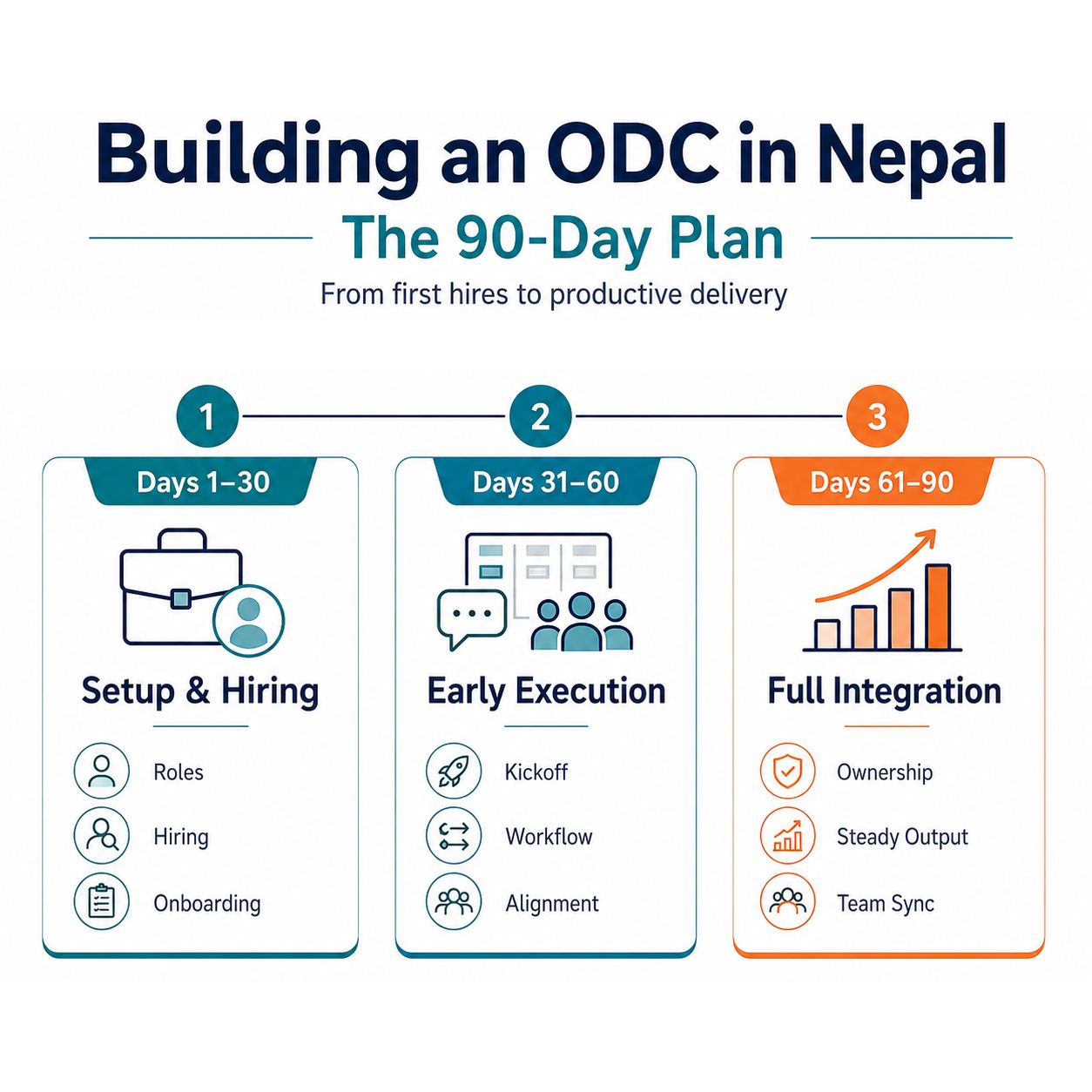
Days 1–30: Setup, Hiring, and Onboarding
The first month is foundational and focuses only on preparation and recruitment. Nothing about it feels glamorous, but skipping steps here creates problems that follow you for months.
1. Choose the Right Technology Stack
Select the technologies the team will use throughout the project, including programming languages, frameworks, databases, cloud platforms, and AI development tools to prevent confusion later.
2. Count the Real Cost Picture
Before you sign anything, get a full-cost estimate, not just the hourly rate and partner fee. New engineers typically experience lower productivity during their first four to six weeks on the job, no matter how experienced they are on paper.
Build that math into your budget now, not in month three when the invoices surprise you.
3. Define Business Goals and Hiring Priorities
Decide what you want the team to achieve, then onboard each member by debriefing them and preparing them to comply with the company’s policy, security requirements, and other details.
4. Legal and Payment Setup
This is also the month to sort out contracts, payment structures, and intellectual property terms.
-
Decide upfront about how you're hiring (an agency, a staffing platform, or engaging an Employer of Record). Each option changes how payroll, taxes, and IP ownership work, so nail this down before your new hires start their first sprint.
-
Pay close attention to the IP clause, specifically if you want to assign all code, designs, and documentation to your company from the moment it's created, not just at the end of the contract.
-
Also decide how you'll handle payments because wire transfers, international payroll platforms, and Employer of Record services all operate differently in terms of timing, fees, and currency conversion.
5. Establish Communication Channels and Agile Workflows
Decide on how everyone will communicate and cooperate to stay aligned: daily standups, weekly sprint planning, sprint reviews, and retrospectives.
Plus, given the time zone gap, agree early on a daily overlap window, even if it's just two or three hours, where both sides are reliably online.
What to expect by day 30: Your team is hired, contracts are signed, tools are set up, and the first few onboarding calls are behind you. Output will still be light. That's normal.
Days 31–60: Early Execution and Workflow Adjustment
Here the real work begins, and where most friction shows up, too.
1. Productivity Starts Climbing
By now, your new hires have moved past the steepest part and understand your codebase, your product, and your expectations far better than they did on day one.
Now, you'll start to see a real, shipped workload in this window.
2. Communication Habits Take Shape
Expect some early misunderstandings around scope, priorities, or technical decisions as teams take in the company’s vision.
For smoother communication, prepare clearer written documentation, specific acceptance criteria, and a shared source of truth for requirements.
3. Process Refinement
By week six or seven, patterns will emerge, like standups running too long and async updates working better than live calls given the time difference.
Use this stage to adjust your workflow based on what you're observing, incorporate feedback from both teams, and improve continuously.
4. Watch for These Early Warning Signs
-
Vague or missing documentation causing repeated back-and-forth
-
Deadlines slipping without clear communication about why
-
Code quality that doesn't match what was promised during vetting
-
Team members going quiet instead of flagging blockers early
Catching these signs now, in month two, is far easier than fixing them in month four.
What to expect by day 60: Your team is producing real output, your workflows are getting sharper, and you have a much clearer read on individual strengths across the team.
Days 61–90: Full Integration and Steady Output
By the final stretch, your offshore team should start feeling less like an external group and more like a genuine extension of your company.
1. Ownership and Autonomy Increase
Strong offshore developers start taking initiative by this point. They flag potential issues before you ask. They suggest better technical approaches.
If you're not seeing any of this by day 75 or 80, it's worth having a direct conversation about expectations or taking a hard look at whether you have the right people in place.
2. Velocity Becomes Predictable
Sprint estimates start to match actual delivery more closely.
You'll have enough historical data by now to plan future work with real confidence rather than guessing.
3. Culture Solidifies
Team rituals settle in. Whether that's a weekly demo, an async Slack update, or a shared documentation habit, these small routines are what keep a distributed team aligned over the long run.
If they haven't formed naturally by day 90, be intentional about building them.
Offshore development teams commonly cut costs by more than thirty percent while increasing technical capability and scaling operations quickly.
What to expect by day 90: A functioning, integrated team with a track record you can measure, clear workflows, and a realistic view of where to grow next.
Common Mistakes to Avoid in Your First 90 Days
Even strong offshore engagements can stumble over avoidable mistakes. Watch for these:
|
Mistake |
Why It Matters |
|
Underestimating the ramp-up period |
Expecting full productivity in week one sets everyone up for disappointment. |
|
Ignoring the true cost of hiring |
The hourly rate is never the whole picture. Budget for the full-cost multiplier from day one. |
|
Skipping documentation |
Clear, written specs save far more time than they cost to create. |
|
Treating the time zone gap lightly |
A 45-minute offset seems small until it quietly wrecks your meeting schedule. |
|
Micromanaging instead of setting outcomes |
Give your team defined goals and the autonomy to reach them. |
Final Thoughts
Building an offshore team in Nepal works best when companies use the first 90 days to set clear goals, hire carefully, align processes, and build trust. Strong planning helps teams work faster and integrate more smoothly.
With the right BOT partner, businesses can reduce hiring pressure, scale engineering capacity, and build a dedicated team that supports long-term growth.
At Searchable Design, we help businesses build dedicated engineering teams in Nepal through our Build-Operate-Transfer (BOT) model. Use our built-in BOT calculator to find out your annual savings on running a remote engineers’ team in Nepal.
Comments(0)
Your email address will not be published. Required fields are marked *
Recommended Posts
Unlock the Secret of Power BI to Empower Your Data Analysis
Turn Raw Data into Real-Time Intelligence with Power BI
Why More Startups Are Offshoring Data Engineering Roles in 2026
Unlocking Global Talent for Faster, Smarter, Scalable Growth through Offshoring Data Engineering
How to Empower Your Web Development Project in 2025?
Empowering Your Web Build with the Right Strategy, Stack, and Global Talent Network
RECOMMENDED TOPICS
TAGS
- offshoring
- outsourcing
- artificial intelligence
- remote team
- nepal
- web development
- bot model
- data analytics
- digital marketing
- it support
- business process automation
- offshore
- legacy software
- saas
- app development
- sprint planning
- remote engineering
- development
- recommender engine
- ai engine
- cybersecurity
- growth hack
- tiktok
- seo
- voice search optimization
- engineering team
- modular app
- cloud based
- api based
- data entry
- api workflow
- service level agreements
- data warehouse
- database
- cloud storage
- engineering
- bot
- scalability
- remote engineers
- insurtech
- global talent pool
- techical consulting
- power bi
- business intelligence
- backoffice
- communication
- outsource
- it roles
- data engineering
- data engineer
- content development
- business development
- offshore talent
- agentic ai
- insurance
- web security
- project management
- pms
- project management system
- agile methodology
- data
- data centric approach
- customer insight
- it infrastructure
- it sustainability
- cloud computing
- data decision
- off
- test
About
Data Not Found
NEWSLETTER
Related Posts

How to Empower Your Web Development Project in 2025?
Empowering Your Web Build with the Right Strategy, Stack, and Global Talent Network

Benefits of Technical Consulting in Professional Marketing Strategy
Bridging Innovation and Strategy for Unstoppable Growth