
Aagya Khatri on Feb 25, 2026
Reading Time: 6 Min
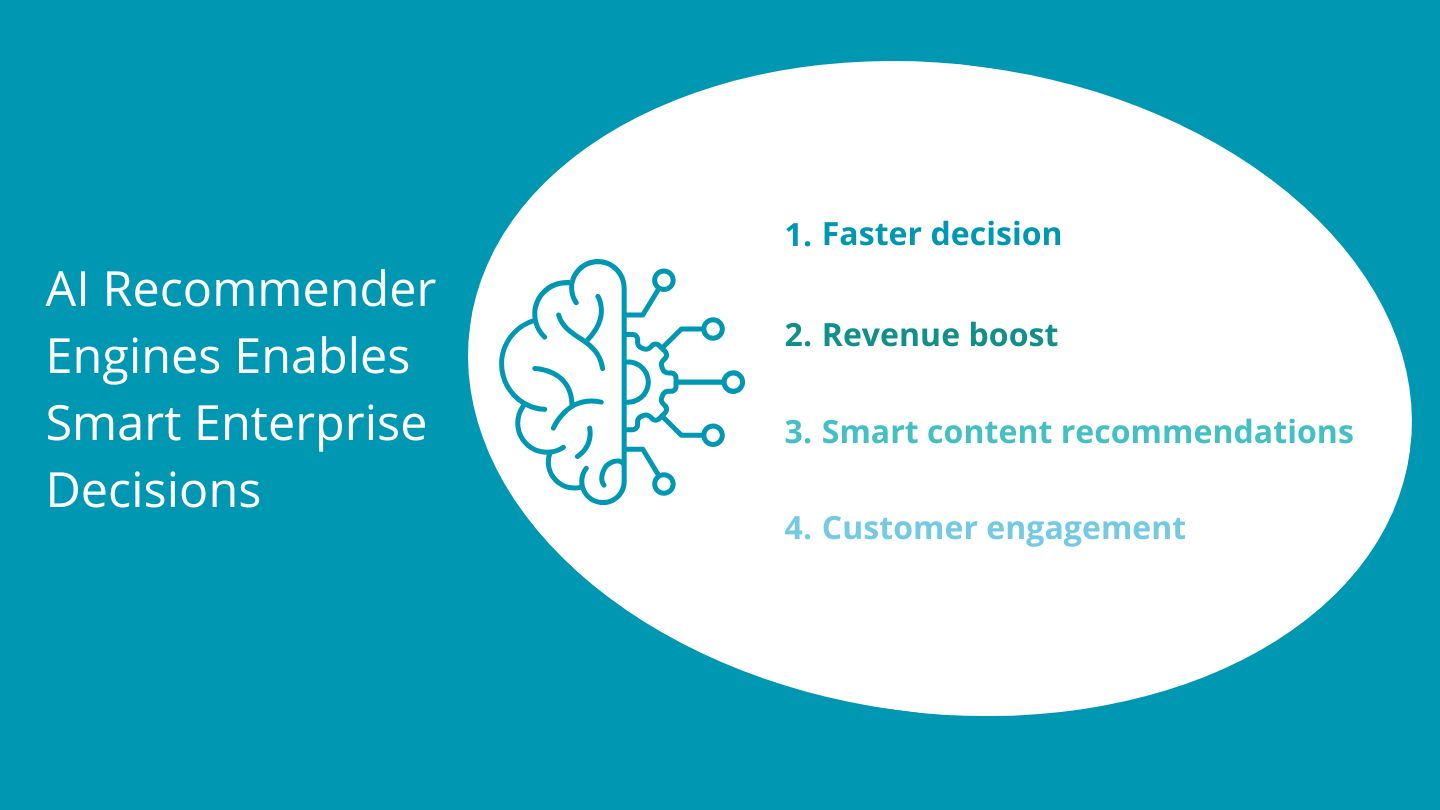
Data alone doesn’t create intelligence. What matters now is how quickly and accurately enterprises can turn massive data into confident decisions.
That’s where AI-based recommender engines come in. Powered by machine learning, they analyze vast datasets in real time, spot hidden patterns, and deliver personalized recommendations.
For example, an e-commerce retailer using these engines saw a 28% jump in average order value by suggesting the right products at the right moment. Similarly, the popular OTT platform Netflix uses an AI recommender to suggest interesting content to its users, where roughly three-quarters (75%–80%) of all viewing activity stems directly from recommendations.
Applying an AI-based recommender engine in enterprise applications can prove to be a game-changer when studied and implemented with measurable test results.
What Are AI Recommender Engines
AI recommender engines are machine learning models designed to analyze massive volumes of structured and unstructured data using labeling, uncover hidden patterns, and predict appropriate actions based on users’ history, interests, and other variables like device, gender, income grade, etc.
They collect information from CRM systems, ERP platforms, web analytics tools, customer behavior logs, and IoT sensors, and run it through trained models employed through APIs. Platforms like Amazon, Netflix, and Spotify are the major implementers of these engines.
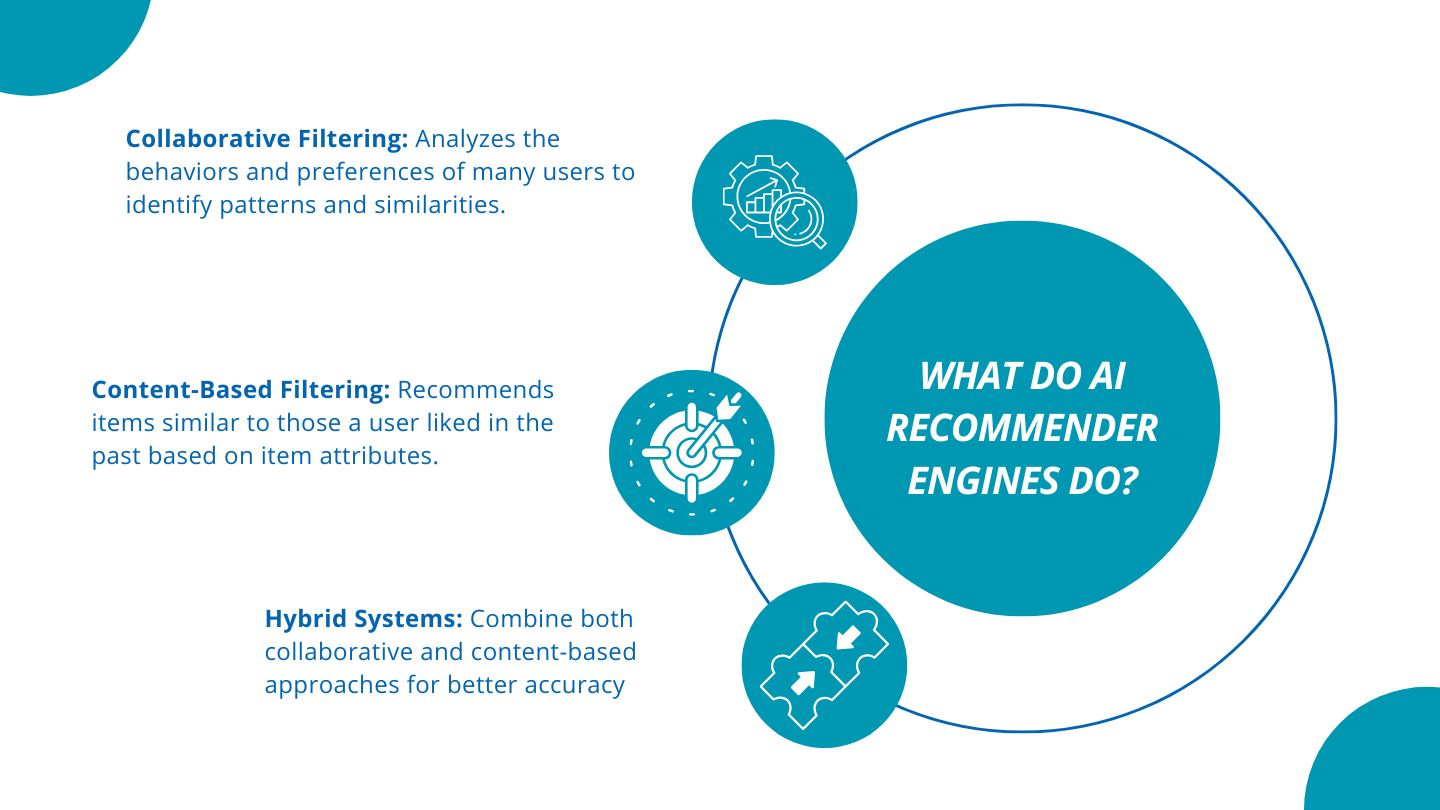
In simple terms, AI recommender engines:
- Analyzes user behavior and interactions to recommend items based on the preferences of other similar users.
- Focuses on the features of items and recommends similar products that the user scrolls longer.
- Combines collaborative and content-based methods for higher accuracy.
- Can help with strategic planning, resource allocation, and inventory management in large-scale enterprises, too.
How Does It Work?
- Data Layer → Collect clicks, purchases, views, etc.
- Feature Layer → Create user & item embeddings (vectors)
- Candidate Generation → Find similar items fast (ANN / Two-Tower)
- Ranking Layer → Score candidates with a deep learning model
- Re-ranking → Apply business rules (diversity, freshness, promotions)
How AI Recommender Engines Drive Smarter Enterprise Decisions
The lifecycle of AI recommender engines is simpler. Analyze data -> Run through tests -> Evaluate results and implement appropriate actions.
AI recommender engines influence multiple layers of enterprise decision-making, including daily operations, revenue growth, and strategic planning, such as increasing the user base or engagement rate over time.
Here are the key business areas where AI recommender engines make a major impact.
1. Enhancing Customer Experience
For both online and offline brands, customer experience has become a major growth driver. People now expect brands to understand their needs and preferences and to suggest the right products with precision.
AI recommender engines make this possible by connecting behavioral data, transaction history, demographics, and contextual signals such as location or device type.
Using these, businesses can deliver relevant and personalized experiences across websites, mobile apps, emails, and support channels.
Here is how AI improves customer engagement
- Recommend products based on browsing and purchase behavior.
- Predict future customer needs.
- Personalize content across digital channels.
- Increase conversions and customer loyalty.
- Learn from every user interaction.
AI recommenders significantly boost customer engagement, typically driving a 26% increase in conversion rates, a 11% increase in average order value (AOV), and 35-70% higher overall website engagement.
2. Improving Operational Efficiency
Enterprises manage complex operations that involve supply chains, inventory, pricing, staffing, and logistics.
AI recommender engines analyze historical performance data, real-time operational signals, and predictive patterns to suggest smarter operational decisions.
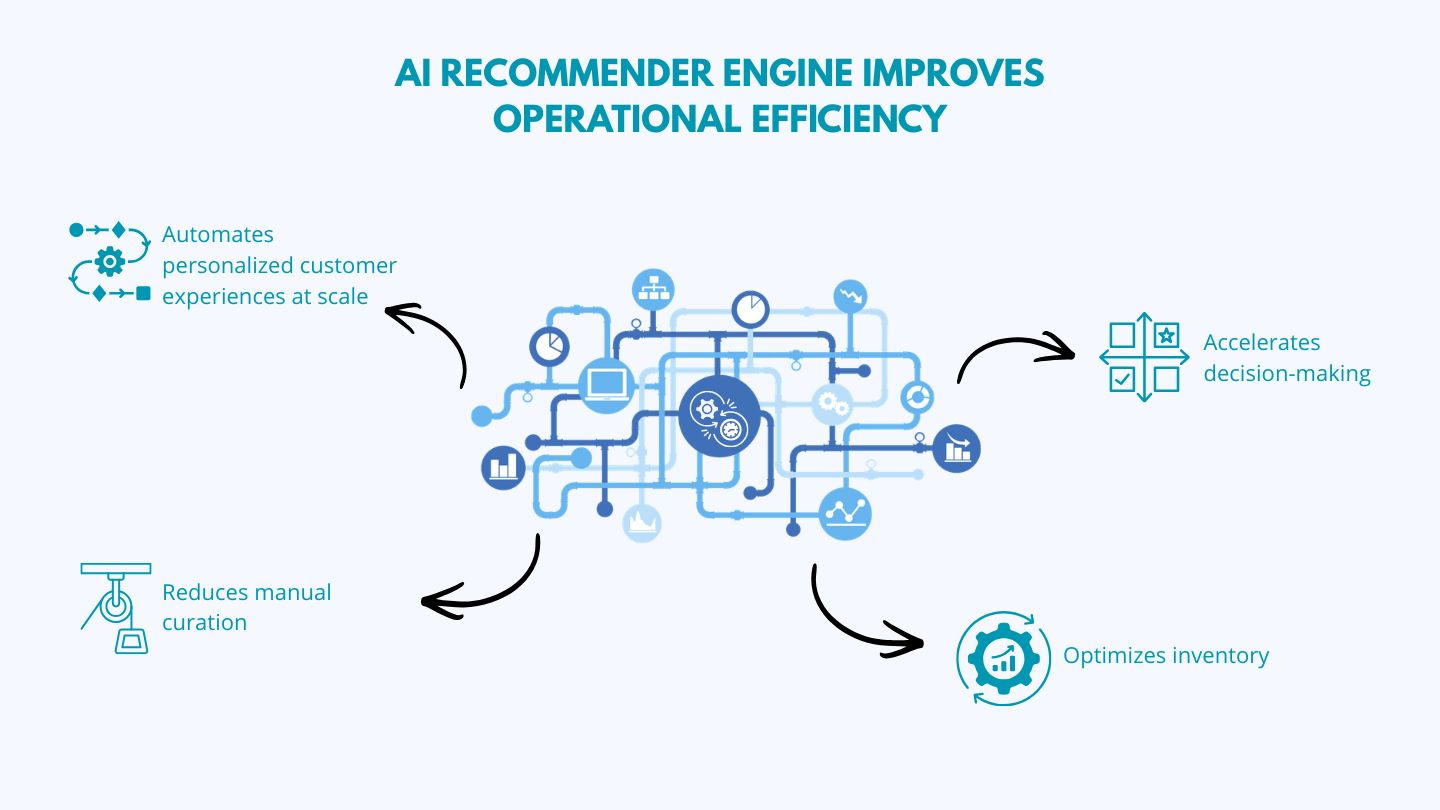
It allows teams to move from reactive problem-solving to proactive action.
Here is where efficiency improves
- By forecasting product demand with higher accuracy.
- By reducing overstocking and preventing stockouts.
- By suggesting optimal pricing strategies based on market behavior.
- Better workforce and asset allocation by predicting workload and requirements.
- Detecting bottlenecks in the process early and suggesting improvements for smoother operations.
3. Driving Revenue and Growth
Sustainable growth comes from understanding and improving customer satisfaction.
AI recommender engines uncover purchasing patterns, identify complementary products, and detect emerging trends, helping enterprises fashion new prospects to increase revenue.
Here is how AI engines drive growth
- Cross-selling and upselling by suggesting complementary or premium products to customers.
- Identifying profitable customer segments allows targeted campaigns to segment the market and gather better ROI.
- Analyzing trends and feedback to suggest new and trendy offerings to customers.
- Helping grow customer retention through personalized experiences.
4. Data-Driven Strategic Decision Making
AI recommender engines empower business executives to make data-driven strategic decisions rather than relying solely on intuition.
They analyze historical data, current trends, and use predictive models to provide leaders with clearer visibility into potential outcomes.
Here is how strategy becomes stronger
- By identifying emerging patterns and trends in consumer behavior or as market demand.
- By evaluating potential outcomes of strategic decisions using AI scenarios.
- By predicting potential risks and providing mitigation strategies.
- By optimizing budget allocations, i.e., recognizing which initiatives are likely to yield the highest returns.
- By tracking KPIs and recommending adjustments in real-time.
5. Integration across Enterprise Functions
AI recommender engines have a real impact only when deeply embedded in enterprise systems rather than treated as standalone tools.
They must be connected to core systems such as customer relationship management, resource planning, HR management, supply chain, and financial systems.
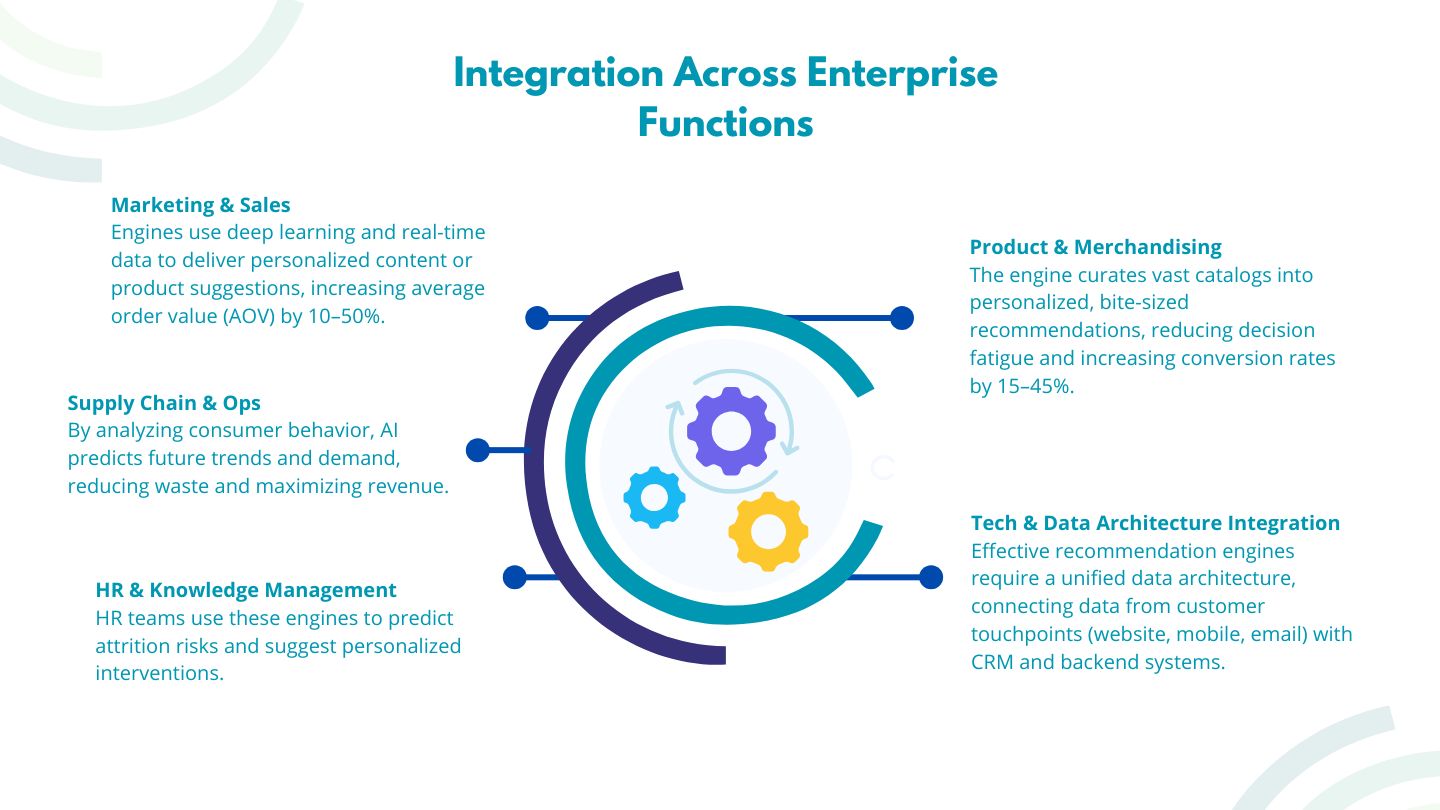
When connected through APIs and data pipelines, these engines continuously ingest data, analyze it, and push actionable recommendations directly into the workflows where decisions are made.
Here is where integration adds value
- Personalization of campaigns, targeted promotions, and lead prioritization in sales and marketing.
- Predictive hiring, employee engagement suggestions, and workforce planning in human resources.
- Optimized routing, demand forecasting, and vendor selection in supply chain management.
- Fraud detection, credit scoring, and investment recommendations in finance and risk management.
- Guidance based on user feedback and market trends in product development.
Challenges and Future Outlook
Implementing AI recommender engines is not a one-time project. It requires a strong technical foundation, continuous monitoring, and ongoing iteration.
Enterprises must define governance frameworks to collect, secure, and use data, establish quality data streams, and regularly train models with fresh findings to adapt to changing user behavior and market conditions.
Key areas to focus on for successful implementation
|
Best Practice |
Why It Matters |
|
Ensure data is accurate, complete, and consistently updated |
High-quality fresh data is the foundation of reliable and relevant recommendations |
|
Continuously monitor models for bias and performance changes |
Early detection prevents unfair results and maintains accuracy over time |
|
Integrate smoothly with core business systems and workflows |
Seamless integration drives real adoption and maximum business impact |
|
Retrain models regularly using fresh and relevant data |
Keeps recommendations current as customer behavior and trends evolve |
|
Stay tuned for new trends in deep learning, NLP, and automation |
Helps your system stay competitive and benefit from the latest performance gains |
Conclusion
AI-based recommender engines turn complex data into a clear direction. They help enterprises better understand customers, analyze the market, operate smarter, grow faster, and plan with confidence.
For businesses that want to compete on intelligence, not instinct, recommender engines are an essential, potent tool.
Partner with Searchable Design, the most trusted data-driven company in Urbandale, to empower you enterprise application with scalable, AI tools.
Comments(0)
Your email address will not be published. Required fields are marked *
Recommended Posts
Unlock the Secret of Power BI to Empower Your Data Analysis
Turn Raw Data into Real-Time Intelligence with Power BI
Why More Startups Are Offshoring Data Engineering Roles in 2026
Unlocking Global Talent for Faster, Smarter, Scalable Growth through Offshoring Data Engineering
How to Empower Your Web Development Project in 2025?
Empowering Your Web Build with the Right Strategy, Stack, and Global Talent Network
RECOMMENDED TOPICS
TAGS
- offshoring
- outsourcing
- remote team
- artificial intelligence
- nepal
- web development
- bot model
- data analytics
- digital marketing
- it support
- business process automation
- offshore
- bot
- legacy software
- saas
- app development
- development
- remote engineering
- recommender engine
- ai engine
- cybersecurity
- growth hack
- tiktok
- seo
- voice search optimization
- engineering team
- sprint planning
- modular app
- cloud based
- api based
- data entry
- api workflow
- service level agreements
- data warehouse
- database
- cloud storage
- engineering
- scalability
- remote engineers
- insurtech
- global talent pool
- techical consulting
- power bi
- business intelligence
- backoffice
- communication
- outsource
- it roles
- data engineering
- data engineer
- content development
- business development
- offshore talent
- agentic ai
- insurance
- web security
- project management
- pms
- project management system
- agile methodology
- data
- data centric approach
- customer insight
- it infrastructure
- it sustainability
- cloud computing
- data decision
- off
- test
About
Data Not Found
NEWSLETTER
Related Posts
How to Take Advantage of Agentic AI – Deploying Autonomous Agents to Power Admin Tasks
Turn routine operations into self-managing systems powered by intelligent, adaptive AI agents.
How AI is Empowering SaaS Adoption? Tips for Startups and Enterprises
Turning software from static tools into intelligent, self-guided experiences