Aagya Khatri on May 19, 2026
Reading Time: 6 Min
Enterprises generate massive amounts of data each day. For instance, Netflix tracks the viewing history, searches, and viewing duration of millions of its users, resulting in hundreds of Terabytes of data. Now, imagine retrieving and integrating these data into your sales or marketing pipeline.
If your team is waiting hours (or days) for reports, struggling to scale during peak seasons, or manually fixing broken pipelines, your current data stack is quietly costing you time, money, and competitive advantage.
Modern data stacks change the game. By adopting cloud-native platforms, real-time analytics, automated pipelines, and scalable architectures, forward-thinking companies are now:
- Reducing report generation time from hours to seconds
- Enabling true real-time dashboards and decision-making
- Cutting infrastructure costs by up to 60%
- Seamlessly integrating AI and machine learning on fresh data
If you are experiencing sluggish performance, limited scalability, or a lack of real-time analytics, it’s time to modernize.
Why It Is Time to Switch to a Modern Data Warehouse
Modern data warehouses stand out from legacy data centers in many facets.
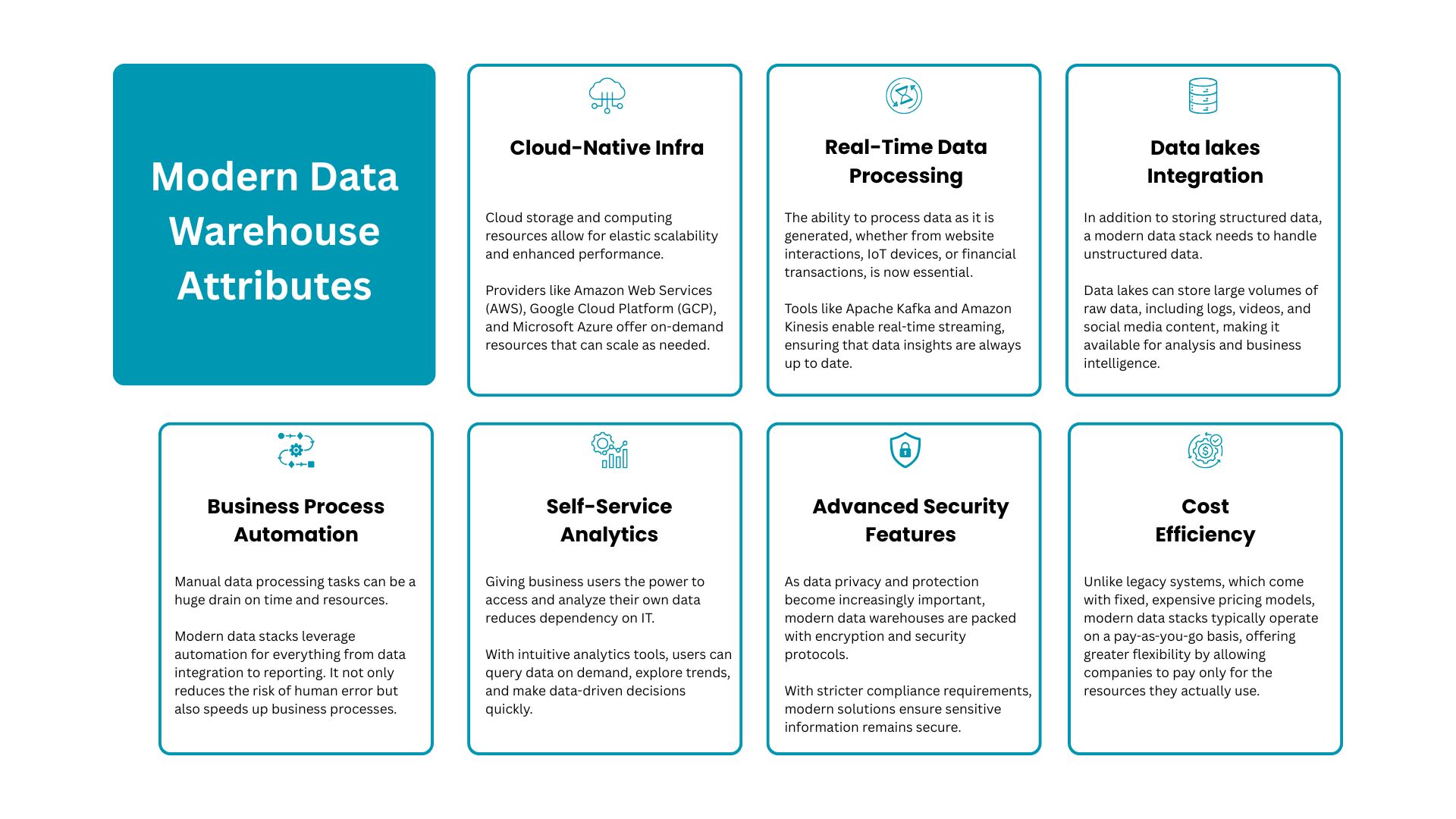
Here are a few standout attributes of the modern data stack that can address the challenges your business might be facing.
How to Tell Your Data Warehouse is Holding You Back
Traditional data warehouses were built for a time when businesses mainly relied on structured, historical data. Today, it entails slow reporting, limited scalability, rising maintenance costs, and difficulty handling large volumes of data.
Today, the time has changed. The data is getting more complex and robust, with enterprises seeking real-time insights to scale their sales or marketing campaigns.
Here are some common signs that your current data warehouse may be holding your business back.
|
# |
Red Flag |
Description |
|
1 |
Slow Query Performance |
When queries take minutes or even hours to run, it is a major red flag. Speed is essential for effective decision-making, especially when dealing with large volumes of data. |
|
2 |
Data Silos |
If different teams or departments are fragmented and working with isolated data, it is a clear sign that your data warehouse is not optimized for collaboration and accessibility. |
|
3 |
Inflexibility to Scale |
Scaling up your data infrastructure should be seamless. If your current setup requires expensive hardware upgrades or complex configurations to handle increased data loads, it is time to upgrade. |
|
4 |
Limited Access to Real-Time Insights |
Legacy data warehouses often batch-process data, causing a lag before the latest information is available. If real-time insights are unavailable, the system is not useful for modern business needs. |
|
5 |
High Maintenance Costs |
Older data warehouses can be expensive to maintain, especially if they are on-premises. Manual updates, patching, and troubleshooting consume valuable resources. |
|
6 |
Inability to Handle Unstructured Data |
If your data warehouse struggles with unstructured data such as images, videos, PDFs, or social media content, it limits your ability to extract value from diverse data sources. |
|
7 |
Complexity of Use |
A complex user interface for employees to access and work with data is another major sign. A modern solution should offer a simple, intuitive interface for users across departments. |
Key Steps to Adopt a Modern Data Stack
This one is crucial, as implementing a modern data stack takes time, money, and resources and is usually done with a reliable IT partner in stages that rarely disrupt your operations while allowing infrastructure to scale.
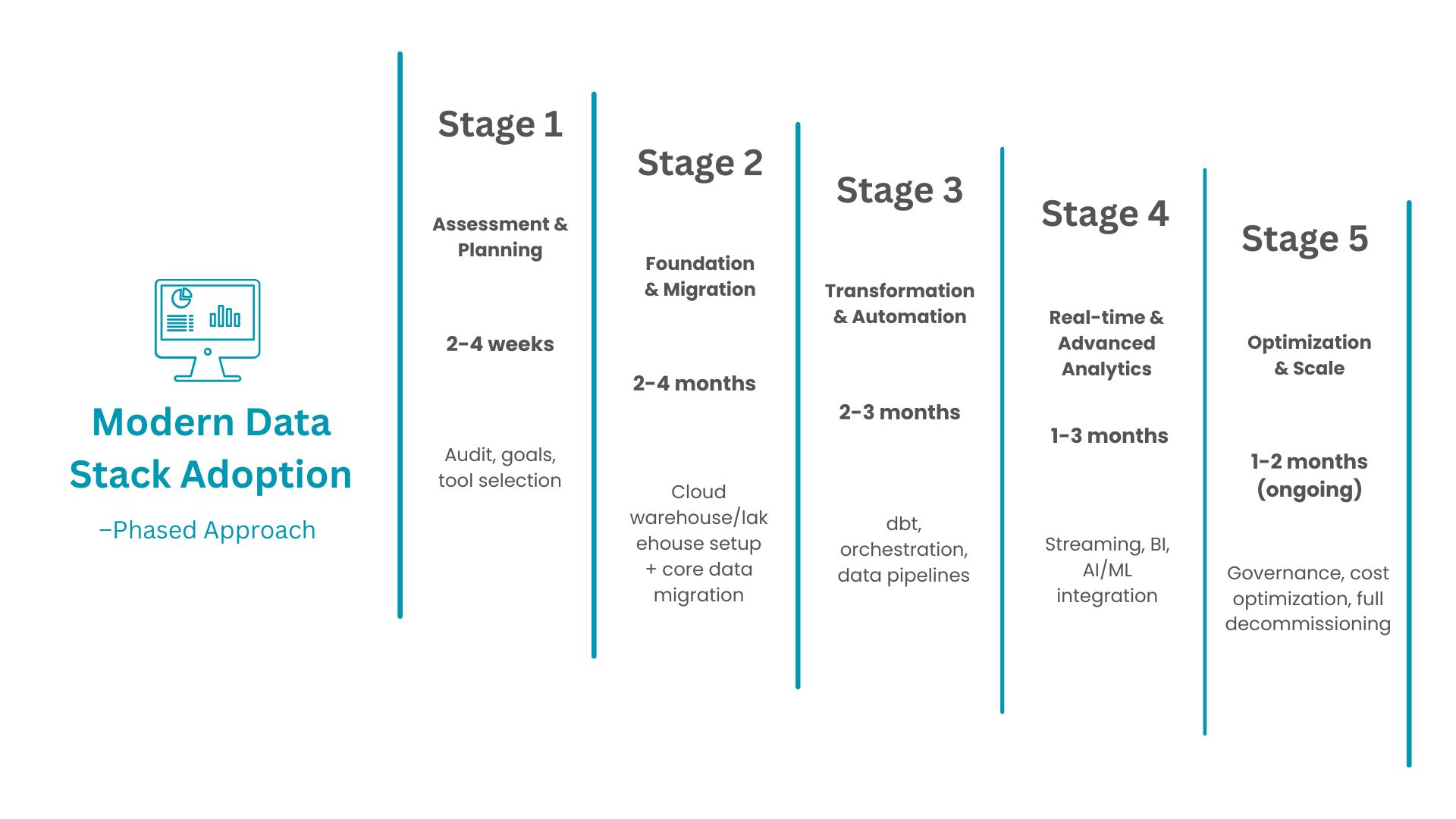
Here is a breakdown of each stage and the actions within.
|
Step |
Action |
Description & How to Execute |
Key Tools / Benefits |
|
1 |
Assess Current State |
Conduct a full audit of existing data infrastructure, tools, pain points, data flows, and team challenges. |
Identify bottlenecks (slow queries, data silos, high costs) |
|
2 |
Define Goals & KPIs |
Align modernization with business objectives such as real-time analytics, cost reduction, scalability, or AI readiness. |
Set measurable targets (e.g., reduce query time by 80%, cut costs by 40%) |
|
3 |
Choose Modern Architecture |
Decide on Cloud Data Warehouse, Lakehouse, or Hybrid architecture. |
Snowflake, Databricks, BigQuery, Redshift |
|
4 |
Build Core Data Pipelines |
Implement automated ingestion, transformation, and orchestration layers. |
Fivetran/Airbyte, dbt, Airflow/Prefect |
|
5 |
Enable Real-Time Processing |
Integrate streaming pipelines for real-time data ingestion and analytics. |
Apache Kafka, Kinesis, Flink |
|
6 |
Implement Data Governance |
Set up data catalog, lineage, quality, security, and compliance frameworks. |
DataHub, Collibra, Great Expectations |
|
7 |
Modernize Data Consumption |
Upgrade BI tools and enable self-service analytics and Reverse ETL. |
Looker, Tableau, Sigma, Census/Hightouch |
|
8 |
Phased Migration |
Migrate data and pipelines in phases — start with high-impact use cases. |
Reduces risk and allows quick wins |
|
9 |
Upskill Teams |
Train existing staff and hire Analytics Engineers and Data Engineers. |
Build an internal data culture and reduce dependency on external consultants |
Overcoming Challenges When Implementing a Modern Data Stack
Transitioning to a modern data warehouse comes with its own set of challenges, especially for large organizations with complex legacy systems.
Here are some common challenges organizations should overcome when transitioning to a modern data stack.
- Transferring large volumes of data while maintaining accuracy and minimizing disruptions.
- Ensuring new platforms work smoothly with current applications and business tools.
- Keeping data secure, organized, and compliant across multiple sources and platforms.
- Planning budgets carefully to manage cloud usage, infrastructure, and implementation costs.
- Helping teams adapt to new systems through training and change-management strategies.
- Reducing downtime and maintaining business continuity during the transition process.
Conclusion
To stay competitive, organizations must adopt cloud-native, scalable, and flexible solutions that deliver a real-time, scalable data environment.
Partner with Searchable Design, the best data-driven Company in Urbandale, to modernize your data infrastructure and build a smarter, faster, and future-ready business.
Comments(0)
Your email address will not be published. Required fields are marked *
Recommended Posts
Unlock the Secret of Power BI to Empower Your Data Analysis
Turn Raw Data into Real-Time Intelligence with Power BI
Why More Startups Are Offshoring Data Engineering Roles in 2026
Unlocking Global Talent for Faster, Smarter, Scalable Growth through Offshoring Data Engineering
How to Empower Your Web Development Project in 2025?
Empowering Your Web Build with the Right Strategy, Stack, and Global Talent Network
RECOMMENDED TOPICS
TAGS
- offshoring
- outsourcing
- artificial intelligence
- remote team
- nepal
- web development
- bot model
- data analytics
- digital marketing
- it support
- business process automation
- offshore
- legacy software
- saas
- app development
- sprint planning
- remote engineering
- development
- recommender engine
- ai engine
- cybersecurity
- growth hack
- tiktok
- seo
- voice search optimization
- engineering team
- modular app
- cloud based
- api based
- data entry
- api workflow
- service level agreements
- data warehouse
- database
- cloud storage
- engineering
- bot
- scalability
- remote engineers
- insurtech
- global talent pool
- techical consulting
- power bi
- business intelligence
- backoffice
- communication
- outsource
- it roles
- data engineering
- data engineer
- content development
- business development
- offshore talent
- agentic ai
- insurance
- web security
- project management
- pms
- project management system
- agile methodology
- data
- data centric approach
- customer insight
- it infrastructure
- it sustainability
- cloud computing
- data decision
- off
- test
About
Data Not Found