
Aagya Khatri on Apr 27, 2026
Reading Time: 7 Min
Outsourcing promises efficiency, cost savings, and access to global talent, but many organizations lose control once operations move outside their walls.
Misaligned expectations, vague contracts, and weak governance often lead to service failures, hidden costs, and dependency risks.
For instance, when General Electric (GE) decided to outsource a large part of its finance and accounting ops back in the late 1990s, many expected the usual pitfalls, but GE turned it around by creating a clear, detailed Service Level Agreement (SLA) on day one, maintaining strong oversight, and standardizing Workflows that provided full transparency, real-time reporting, and compliance decisions.
The real key to successful outsourcing isn’t just finding the right partner — it’s governing the relationship effectively.
Let's learn how to structure contracts, define SLAs, and build back-sourcing to capture the benefits of digital outsourcing.
Why Building a Governance-First Outsourcing Makes a Crucial Strategy
Outsourcing often starts with vendor selection. However, it should start with governance law.
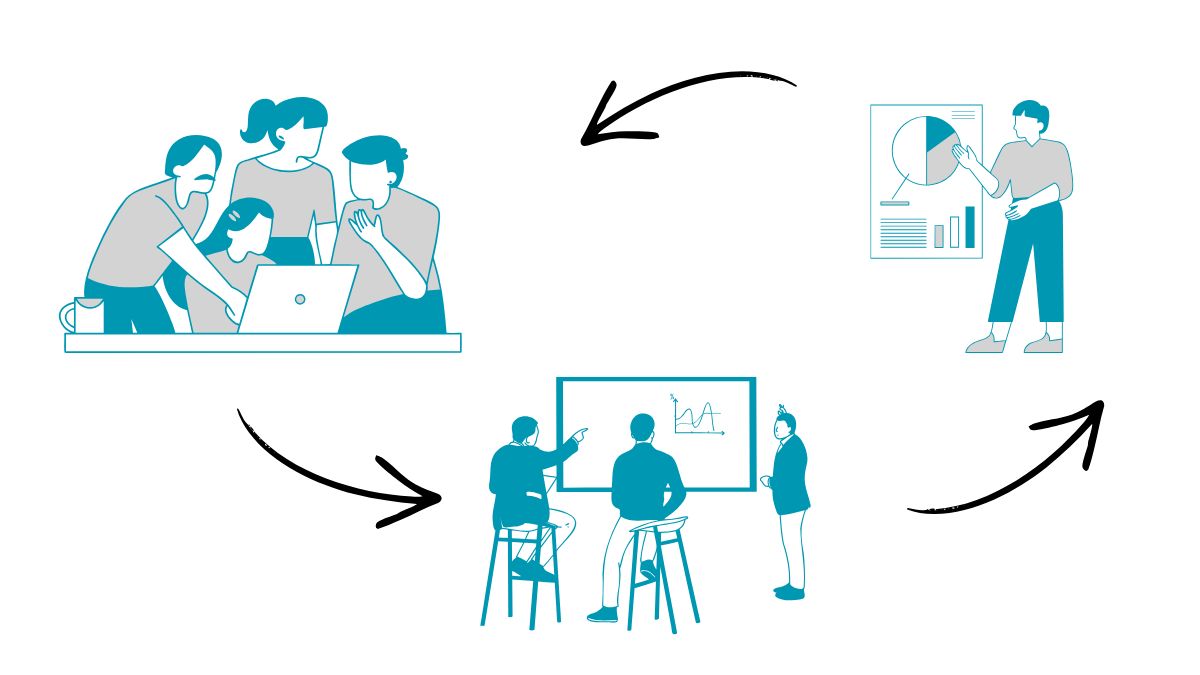
A strong governance framework aligns business goals, defines decision-making authority, and ensures accountability across both internal and external teams, creating a shared language between you and your outsourcing partner and reducing ambiguity and conflict in the future.
Although the benefits shared are mutual, enterprises often have an upper hand through governance law when it matters.
Here are a few telltale examples.
- Defining clear ownership roles across business, IT, legal, and vendor teams.
- Establishing a decision-making hierarchy to avoid delays during critical service disruptions.
- Matching outsourcing goals directly with measurable business outcomes and KPIs.
- Creating daily, bi-weekly/weekly reviews and monthly governance meetings to realign goals and expectations.
- Documenting conflict handling processes.
- Building cross-functional governance teams to reduce silo-based decision-making risks.
A well-optimized outsourcing strategy helps enterprises reduce costs by transforming fixed, high-cost in-house operations into variable, lower-cost expenses, often reducing total operating costs by 30% to 70%.
A. Designing Protective Contracts
In outsourcing, the contract is the core document that governs the relationship between your company and the vendor.
It should be a technical framework that clearly outlines both the strategic and operational elements of the relationship.
A poorly structured contract can lead to ambiguity and unnecessary friction, resulting in service failures and legal issues.
Here is what a strong outsourcing contract should include:
|
Contract Element |
Description |
Best Practice / Example |
|
Scope of Services |
Clearly defines what services will be delivered in measurable terms |
Instead of “customer support”, specify “Resolve 95% of tickets within 24 hours.” |
|
Pricing and Performance Models |
Moves beyond fixed pricing to performance-based payment structures |
Use the “Pay-for-Performance” model, where a portion of payment is tied to KPIs |
|
Change Management |
Allows flexibility for evolving business and technology needs |
Include clauses for scope changes, pricing adjustments, and technology upgrades |
|
Regulatory Compliance & Data Protection |
Defines responsibilities for legal and data security requirements |
Clearly assign accountability for GDPR, HIPAA, or other relevant regulations |
|
Termination Clauses |
Specifies conditions and procedures for ending the contract |
Include knowledge transfer, data return, and system decommissioning steps |
B. Service Level Agreements
Service level agreements help to take the contract’s framework and apply it to actual performance.
SLAs convert expectations into measurable standards, allowing both parties to track progress, identify risks, and ensure the relationship remains aligned with business objectives.
Good SLAs focus on outcomes, not just activities. Here are the elements required to design effective SLAs,
|
SLA Best Practice |
Description |
Example / Recommendation |
|
Outcome-Based KPIs |
Focus on business impact rather than just activities |
Instead of “number of tickets closed”, measure “System Uptime %” or “Customer Satisfaction Score (CSAT).” |
|
Realistic Performance Thresholds |
Set achievable targets based on historical data and industry benchmarks |
Avoid unrealistic claims (e.g., 30-minute resolution if the industry average is 60 minutes) |
|
Incentives and Penalties |
Include rewards for exceeding targets and consequences for missing them |
Bonus for consistent over-performance + financial penalties for repeated SLA breaches |
|
Continuous Monitoring & Real-Time Data |
Use dashboards for ongoing visibility and quick issue resolution |
Implement real-time dashboards showing downtime, resolution time, and transaction volumes |
|
Regular SLA Reviews & Updates |
Review and update SLAs periodically to match changing business needs |
Conduct quarterly or bi-annual SLA reviews to adapt to new priorities and technologies |
3. Back-Sourcing Safeguards
Back-sourcing is the process of bringing services that were previously outsourced to an external provider back in-house or switching to a different vendor after working with one for a while.
Whether it is due to the vendor failing to meet expectations or a business decision to move services back in-house, back-sourcing can be a complex and disruptive process.
Planning for this in advance ensures your company can easily regain control of its operations, data, and intellectual property when necessary.
Here are the technical aspects of Back-Sourcing Safeguards,
|
Component |
Description |
Why It Matters |
|
Data Portability and Ownership |
Clearly define who owns the data and ensure seamless return of all customer data, records, and proprietary information upon contract end. |
Prevents data lock-in and ensures quick, hassle-free recovery |
|
Documentation and Process Knowledge |
Require the vendor to maintain comprehensive, up-to-date documentation of systems, processes, and workflows. |
Allows your internal team to understand operations without starting from scratch |
|
Knowledge Transfer Plans |
The vendor must provide training sessions, detailed documentation, and hands-on support to your team. |
Ensures smooth handover of knowledge and reduces dependency risks |
|
Transition Timelines and Responsibilities |
Clearly outline timelines, steps, and responsibilities for moving services back in-house. |
Avoids chaos and delays during the transition period |
|
Internal Readiness |
Your organization must maintain internal capabilities, trained resources, and backup systems. |
Minimizes operational disruption when bringing operations back in-house |
5 Most Important Things Every Enterprise Should Know When Outsourcing/Offshoring Tech Projects
If you are new to outsourcing, start with a small pilot project before committing to large-scale work. It helps you test the vendor’s real capabilities in security, communication, and delivery quality.
However, if your requirement is robust and calls for a longer partnership, here are five things to remember.
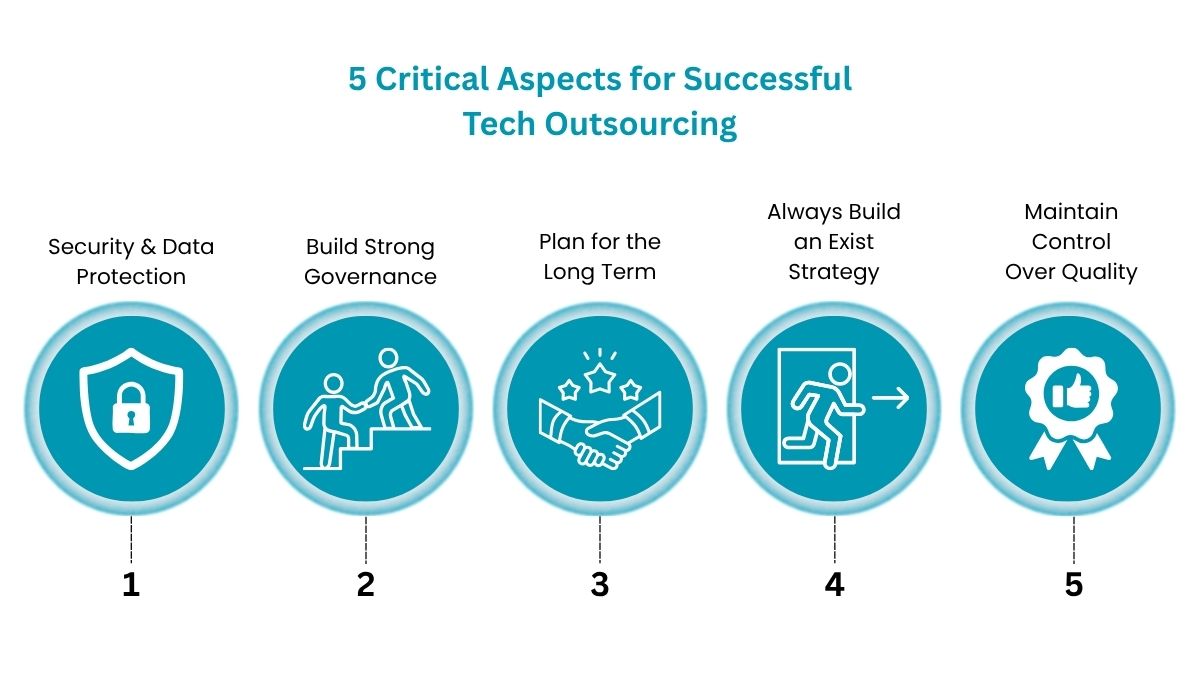
1. Security & Data Protection is Non-Negotiable
Never assume the vendor’s security standards match yours.
Clearly define data ownership, encryption requirements, access controls, compliance (GDPR, ISO 27001, SOC 2, etc.), and incident response obligations in the contract.
Regular security audits and penetration testing should be mandatory, not optional.
2. Build Strong Governance, Not Just a Contract
A good contract is important, but strong governance is what actually protects you.
Establish multi-level governance (executive + operational), regular performance reviews, escalation matrices, and joint steering committees. Weak governance is the #1 reason outsourcing relationships fail.
3. Plan for the Long Term, Treat It as a Strategic Partnership
Successful outsourcing is not a one-time transaction.
Choose vendors you can grow with. Focus on cultural alignment, transparency, and mutual success. The best partnerships evolve from “vendor-client” to “strategic extension of your team.”
4. Always Build an Exit Strategy (Back-sourcing Plan)
Every outsourcing contract should include clear exit clauses: data portability, knowledge transfer, transition timelines, and support during handover.
Never become so dependent on a vendor that you cannot bring the work back in-house if needed.
5. Maintain Control over Architecture & Quality
Do not fully outsource critical architectural decisions or quality ownership. Keep core architecture, code standards, and final quality gates under your control.
Use the vendor for execution and scale, but retain strategic oversight. It prevents technical debt and makes future upgrades or switching vendors much easier.
Conclusion
Outsourcing or offshoring digital projects is not just about overhead cost savings or chasing automation. It is about building a partnership that benefits both and empowers scalability, security, and growth.
The above prerequisites can significantly enhance your governance playbook for digital outsourcing. Contracts must be strongly governed, SLAs must be meaningful, and back-sourcing safeguards must be built from day one.
If you are ready to take control of your outsourcing strategy, contact Searchable Design, the leading outsourcing company, for web and cross-functional app development, back office support, and data analytics services. Let’s build a strong, future-proof model together.
Comments(0)
Your email address will not be published. Required fields are marked *
Recommended Posts
Unlock the Secret of Power BI to Empower Your Data Analysis
Turn Raw Data into Real-Time Intelligence with Power BI
Why More Startups Are Offshoring Data Engineering Roles in 2026
Unlocking Global Talent for Faster, Smarter, Scalable Growth through Offshoring Data Engineering
How to Empower Your Web Development Project in 2025?
Empowering Your Web Build with the Right Strategy, Stack, and Global Talent Network
RECOMMENDED TOPICS
TAGS
- offshoring
- outsourcing
- remote team
- artificial intelligence
- nepal
- web development
- bot model
- data analytics
- digital marketing
- it support
- business process automation
- offshore
- bot
- legacy software
- saas
- app development
- development
- remote engineering
- recommender engine
- ai engine
- cybersecurity
- growth hack
- tiktok
- seo
- voice search optimization
- engineering team
- sprint planning
- modular app
- cloud based
- api based
- data entry
- api workflow
- service level agreements
- data warehouse
- database
- cloud storage
- engineering
- scalability
- remote engineers
- insurtech
- global talent pool
- techical consulting
- power bi
- business intelligence
- backoffice
- communication
- outsource
- it roles
- data engineering
- data engineer
- content development
- business development
- offshore talent
- agentic ai
- insurance
- web security
- project management
- pms
- project management system
- agile methodology
- data
- data centric approach
- customer insight
- it infrastructure
- it sustainability
- cloud computing
- data decision
- off
- test
About
Data Not Found
NEWSLETTER
Related Posts
How to Empower Your Web Development Project in 2025?
Empowering Your Web Build with the Right Strategy, Stack, and Global Talent Network

Benefits of Technical Consulting in Professional Marketing Strategy
Bridging Innovation and Strategy for Unstoppable Growth