

Aagya Khatri on Mar 30, 2026
Reading Time: 7 Min
In large enterprises, sales don’t wait. Deals happen every minute, pipelines keep moving, and teams are expected to stay perfectly aligned.
But here’s the reality. A surprising amount of time is still spent on manual data entry, updating CRMs, and juggling disconnected tools. Legacy systems slow things down. Important updates get delayed. Teams end up reacting instead of driving results.
This is where Business Process Automation (BPA) with API-driven workflows changes the game.
Instead of patching together tools, BPA connects your entire sales ecosystem: Data flows in real time, tasks run automatically, and decisions are based on live insights, not outdated reports.
The result is simple: less manual work, fewer errors, faster execution, and stronger revenue growth.
Are you struggling to keep your sales pipelines aligned with the promised growth? Let’s break them down into a true growth engine.
How Does API-Driven Workflows Empower Sales Output?
API workflows are the backbone of modern digital infrastructure, running a series of sequential or conditional steps using multiple APIs. Data from one API call often serves as input or a prerequisite for the next, creating powerful, multi-step processes commonly used in automation.
This chaining action, along with key concepts like System-to-System integration, serverless execution, and machine-readable specs, improves efficiency, speed, scalability, and data accuracy.
Many modern platforms employ BPA to reduce manual effort and minimize errors, leading to lower operational costs and a faster ROI.
For example, BPA in E-commerce helps integrate inventory management, payment gateways, and shipping services to automate order processing.
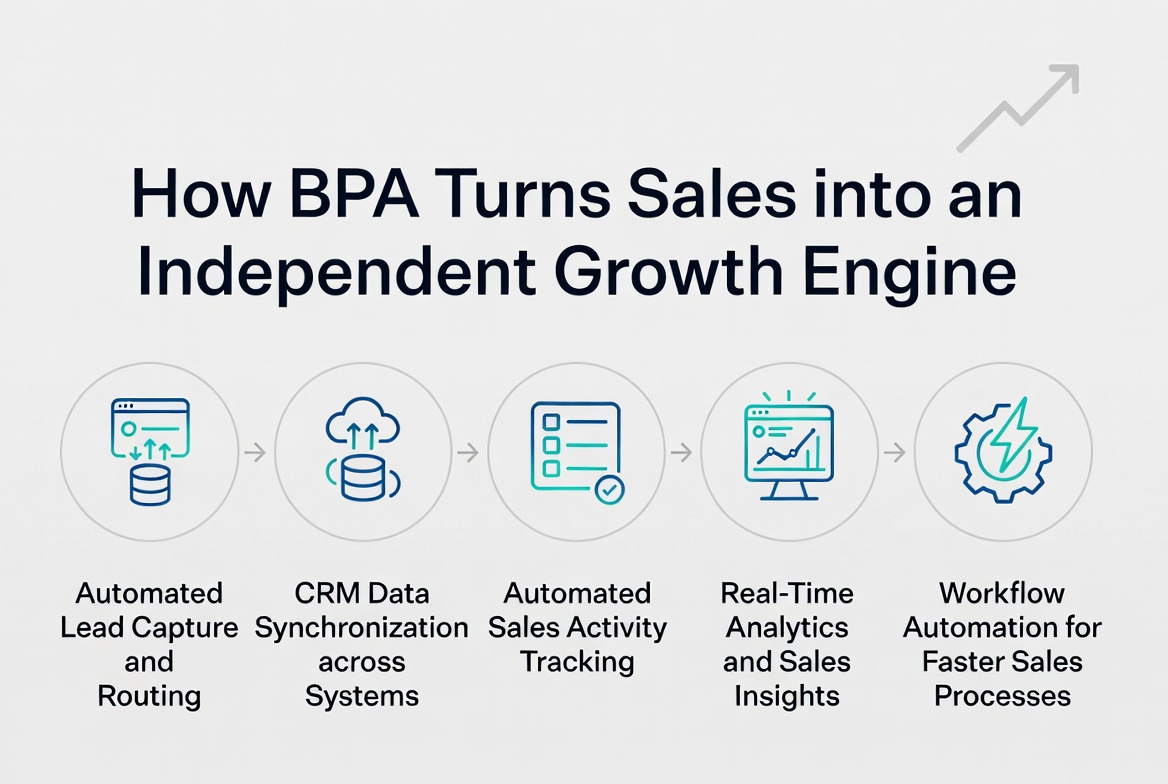
How BPA Turns Sales into an Independent Growth Engine
Sales play a vital role in an organization, from lead and revenue generation to managing delivery processes, acquiring client data, and providing key growth insights.
With BPA, instead of chasing updates, teams operate with continuous visibility. As a result, sales ops evolve from support functions into strategic drivers that actively guide decisions and provide faster responses.
1. Automated Lead Capture and Routing
Lead management is one of the biggest problem areas in sales. With BPA workflows, leads are captured instantly and assigned to the right sales representative, helping teams respond quickly and focus on the best opportunities.
This is How BPA Improves Lead and Sales.
|
Step |
Process |
Benefit |
|
1 |
Website forms capture data and send it directly to CRM |
Automated lead capture with zero manual entry |
|
2 |
Leads are assigned instantly based on rules (region, industry, etc.) |
Faster routing to the right sales team |
|
3 |
Enrichment tools add company and contact details automatically |
Complete and accurate lead information |
|
4 |
Sales reps get alerts as soon as new leads arrive |
Immediate awareness and action |
|
5 |
Faster capture improves response time and conversions |
Higher conversion rates and better sales performance |
2. CRM Data Synchronization across Systems
Sales teams rely on multiple Agentic AI, scheduler, analytics, and standalone tools each day, including robust CRM systems and Salesforce with millions of data.
When these systems are not connected by a single workflow, teams do not have to sync data from various tools. Automation solves this by automatically syncing data across all systems.
When something changes in one platform, it updates everywhere else in real time. As a result, teams can make decisions based on accurate and up-to-date data.
Here is What Better Data Synchronization by BPA Enables
- Customer data updates automatically across all systems.
- Changes appear instantly in every connected tool.
- Duplicate records are reduced or removed.
- Teams work with consistent and accurate information.
- Collaboration improves across departments.
3. Automated Sales Activity Tracking
Sales representatives spend a lot of time logging calls, emails, and meetings into CRM systems.
While this information is valuable for reporting and forecasting, manual entry takes time away from actual selling.
Automation solves this problem by automatically capturing sales activities. Email integrations, call tracking tools, and meeting platforms sync interactions directly into CRM records.
Advantages in Daily Work for Sales Teams
- Emails are automatically logged into CRM.
- Call tracking tools record and update interaction details.
- Meetings are added directly to customer records.
- Activity tracking improves visibility across the pipeline.
- Managers can monitor performance more clearly.
4. Real-Time Analytics and Sales Insights
Traditional sales reporting relies on manual updates and delayed data, making it hard to act quickly.
API-Centric Architecture can empower CRMs to connect various systems into a unified platform, where data is continuously processed into dashboards and reports, providing teams with real-time visibility into sales performance, pipeline health, and deal progress.
Hence, instead of waiting for reports, managers can see what is happening and take action immediately.
Real-time Insights Help Teams with These
- Dashboards update automatically with real-time data.
- Managers track deals without waiting for reports.
- Issues in the pipeline are identified early.
- Forecasts become more accurate.
- Teams adjust strategies quickly.
- Trends and risks are easier to spot.
5. Workflow Automation for Faster Sales Processes
Sales processes include many steps, such as follow-ups, approvals, and document creation. When these steps are done manually, delays are common.
Workflow automation removes these delays by triggering actions automatically when certain conditions are met.
For example, when a deal reaches a new stage, the system can generate proposals, send approval requests, or schedule follow-ups automatically. Instead of building an API architecture from scratch, adopting GPT into your workflow can swiftly help solve this problem.
Here is How GPT-powered Automation Speeds up Sales Processes
- Deal updates trigger automatic proposal creation.
- GPT generates necessary content structures, texts, and visual media.
- Follow-ups are scheduled without manual effort.
- Approval requests are sent instantly to managers.
- Tasks are assigned automatically at each stage.
- Processes stay consistent across teams.
- Sales cycles become shorter and more efficient.
Why It May Be Time to Switch from Legacy to Modular Solutions?
Despite the benefits of automation, many organizations are still stuck with legacy systems because scaling them would require significant time, money, and effort.
These systems rely on manual data entry, fragmented tools, and slow reporting cycles, making data management more complex.
Without automation, teams struggle to keep up with growing demands and miss opportunities to improve performance.
Here is how you can tackle these issues with appropriate solutions.
|
Problem |
Solution |
|
Sales representatives spend excessive time updating CRM systems and spreadsheets |
Automated data capture and synchronization eliminate manual updates |
|
Multiple tools create fragmented data that limits visibility across departments |
Unified modular platform provides real-time, centralized visibility |
|
Lead response times are slower |
Instant lead routing and automated alerts enable faster follow-up |
|
Reports are delayed and less reliable |
Real-time analytics and automated reporting deliver accurate insights instantly |
|
Processes are inconsistent across teams |
Standardized automated workflows ensure consistency across all teams |
|
Lack of integration causes duplicate work across teams |
Seamless integration between systems removes duplication and reduces errors |
A modern modular solution transforms sales into an independent, efficient growth factor by automating lead capture and routing, ensuring real-time CRM synchronization, providing instant analytics and insights, and streamlining workflows across teams.
This shift not only eliminates duplicate work and delays but also empowers sales representatives to focus on high-value activities like closing deals and building customer relationships.
Your sales teams are likelier to respond faster, operate more consistently, and drive sustainable revenue growth in a competitive market.
Conclusion
BPA and API automation turn sales operations into intelligent systems by connecting tools, automating work, and delivering real-time insights that improve decisions and performance.
As a result, sales teams save time, act on better data, and scale faster with more efficient and reliable processes.
Talk to the best data-driven company in Urbandale to streamline your sales operations, implement automation, and drive consistent revenue growth using modular, API-based app solutions.
Comments(0)
Your email address will not be published. Required fields are marked *
Recommended Posts
Unlock the Secret of Power BI to Empower Your Data Analysis
Turn Raw Data into Real-Time Intelligence with Power BI
Why More Startups Are Offshoring Data Engineering Roles in 2026
Unlocking Global Talent for Faster, Smarter, Scalable Growth through Offshoring Data Engineering
How to Empower Your Web Development Project in 2025?
Empowering Your Web Build with the Right Strategy, Stack, and Global Talent Network
RECOMMENDED TOPICS
TAGS
- offshoring
- outsourcing
- artificial intelligence
- remote team
- nepal
- web development
- bot model
- data analytics
- digital marketing
- it support
- business process automation
- offshore
- legacy software
- saas
- app development
- sprint planning
- remote engineering
- development
- recommender engine
- ai engine
- cybersecurity
- growth hack
- tiktok
- seo
- voice search optimization
- engineering team
- modular app
- cloud based
- api based
- data entry
- api workflow
- service level agreements
- data warehouse
- database
- cloud storage
- engineering
- bot
- scalability
- remote engineers
- insurtech
- global talent pool
- techical consulting
- power bi
- business intelligence
- backoffice
- communication
- outsource
- it roles
- data engineering
- data engineer
- content development
- business development
- offshore talent
- agentic ai
- insurance
- web security
- project management
- pms
- project management system
- agile methodology
- data
- data centric approach
- customer insight
- it infrastructure
- it sustainability
- cloud computing
- data decision
- off
- test
About
Data Not Found
NEWSLETTER
Related Posts
How to Take Advantage of Agentic AI – Deploying Autonomous Agents to Power Admin Tasks
Turn routine operations into self-managing systems powered by intelligent, adaptive AI agents.