
Saramsh Gautam on Mar 03, 2026
Reading Time: 8 Min
As the global IT outsourcing market surges past $500 billion in 2026, offshore app development has evolved far beyond mere cost savings; it's now a pivotal strategy for harnessing AI-driven innovation, cloud-native scalability, and specialized expertise to fuel business growth.
The ideal offshore partner can supercharge your timelines with agile methodologies, fortify your apps with advanced cybersecurity and DevOps practices, and minimize risks in an increasingly complex digital landscape, just like any in-house team. Choose poorly, however, and you'll face escalating costs, delayed launches, and compromised quality that could derail your competitive edge.
Driven by cost savings of up to 50% and access to global talent, this trend is a standard operating model for IT, with some studies suggesting up to 79% of companies use offshore, near shore, or onshore services for software and app development, as reported by N-iX, a soft-tech agency.
Here is a proven 4-step framework to navigate these choices with confidence, ensuring you select a collaborator who aligns with the latest trends, such as AI integration and outcome-based models, for maximum impact.
1. Start with Clarity: Scope, Tech Stack, and Metrics
Most offshore development failures start here. Failing to clearly define your scope may affect timely progress.
Before you speak to any partner, define what you are building, how it should be built, and how success will be measured, including documenting product requirements, outlining architecture expectations, and setting performance benchmarks.
If you are unclear about MVP vs full product, AI integrations, compliance needs, or deployment models, here are the things to consider.
|
Aspect |
Details |
|
Core Features and MVP Boundaries |
Define the essential functionalities for the minimum viable product (MVP), including what is in-scope and out-of-scope, to set clear expectations and priorities. |
|
User Personas and Key Workflows |
Identify target user profiles (e.g., demographics, behaviors) and map out critical user journeys to ensure the app effectively meets end-user needs. |
|
Required Integrations and Compliance Standards |
Specify the necessary connections to systems like payment gateways, CRM tools, or external APIs, and ensure adherence to regulations such as GDPR, PCI DSS, and industry-specific standards. |
|
Architecture Model |
Choose an appropriate structure, such as monolithic, microservices, cloud-native, or hybrid, based on scalability, maintainability, and project requirements. |
|
AI Roadmap and Third-Party Service Dependencies |
Outline plans for AI/ML integrations (e.g., features like personalization or automation) and list dependencies on external services like cloud providers or APIs. |
|
Performance KPIs |
Establish key metrics for success, including uptime targets (e.g., 99.9%), page load speeds (e.g., under 2 seconds), and development metrics like sprint velocity. |
Offshore teams execute what you define. Precision at this stage protects your timeline and your budget.
2. Choose Technical Expertise and Specialized Experience
Not all offshore teams are equal; with experience comes expertise, with some specializing in Fintech and others excelling in SaaS or healthcare.
Start by validating specialization through their portfolio, client list, and early demonstrations.
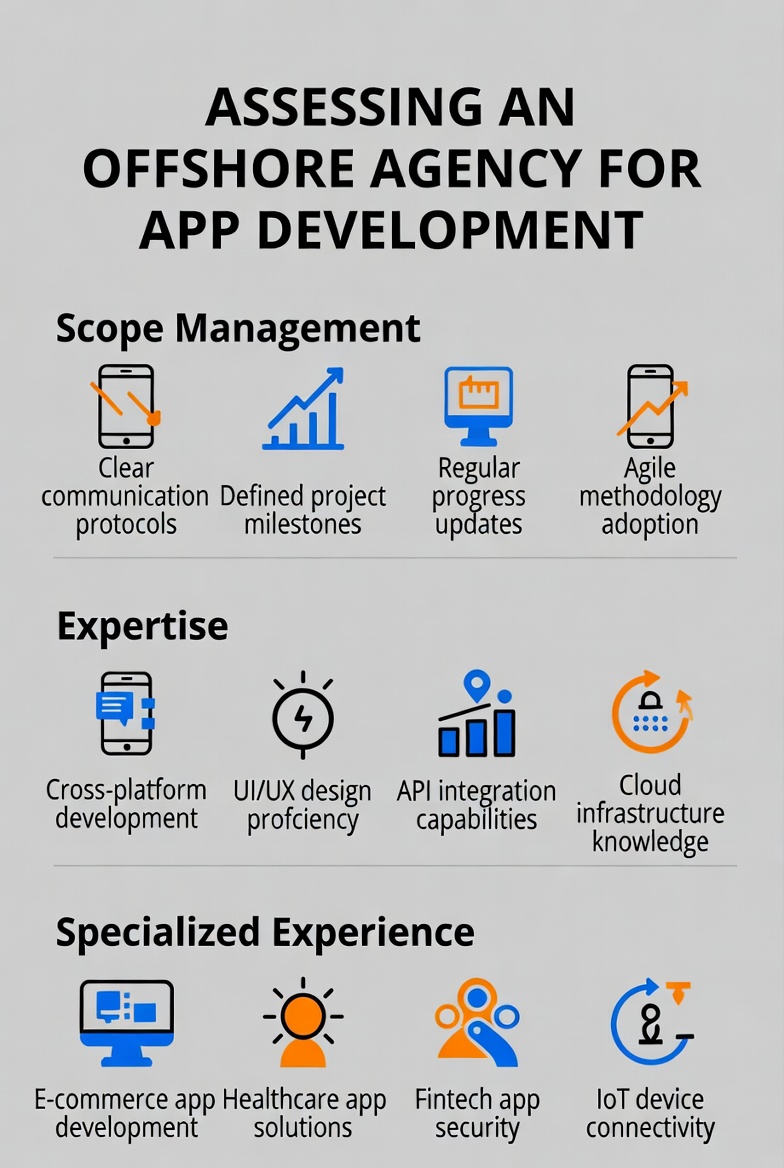
When enterprises evaluate an offshore agency to build an app, it's crucial to focus on key areas such as scope management, overall expertise, and specialized experience.
Below is a structured list of what to assess in each category to ensure alignment with your project needs and mitigate risks.
3. Establish Governance and Security Frameworks
Offshore partnerships fail when expectations about management and control do not align, most often over delivery deadlines, communications, and feedback.
More importantly, offshore teams operate across borders, time zones, and legal systems. Without structured governance, even technically strong teams can create compliance, IP, and cybersecurity risks.
Contracts must define IP ownership and termination terms. Infrastructure access must remain under your company’s control. Security should follow international standards, not informal practices.
Moreover, within the ethics of governance, the contract should also include sprint cadence, reporting structure, escalation paths, and budget transparency.
Here are some Non-negotiables before Starting Development
- Clear IP ownership and NDA agreements.
- Role-based access control and Multi-factor authentication (MFA) enforcement.
- Secure credential management (no shared passwords).
- Secure Software Development Lifecycle (SDLC) and regular vulnerability testing.
- Defined sprint cadence and reporting dashboards, such as Jira.
- Transparent billing structure (hourly, milestone-based, retainer) and change management process.
- Documented incident response for data breaches, downtime, and business continuity plans.
Here are a few crucial tips to keep offshore and in-house management aligned.
|
Area of Alignment |
Best Practices for Offshore Team and Management |
|
Delivery Deadlines |
- Set clear, realistic milestones with mutual agreement at project start. - Use shared project management tools to track timelines and dependencies. - Conduct regular deadline reviews and adjust for risks like time zone differences - Implement buffer periods for unforeseen delays. |
|
Communication |
- Establish daily/weekly stand-ups via video calls to bridge time zones. - Define communication protocols (e.g., response times, preferred channels like Slack or email). - Encourage open channels for questions and clarifications to avoid misunderstandings. - Use collaborative platforms for real-time updates and document sharing. |
|
Feedback |
- Schedule bi-weekly feedback sessions to discuss performance and improvements. - Provide constructive, timely feedback using structured formats (e.g., SBI model: Situation-Behavior-Impact). - Foster a two-way feedback culture where the team can share insights on management processes. - Document feedback in shared tools for tracking resolutions. |
|
Progress Demos |
- Hold bi-weekly or sprint-end demos to showcase deliverables and gather input. - Use screen-sharing tools for live walkthroughs of features and prototypes. - Record demos for asynchronous review by stakeholders in different time zones. - Align demos with KPIs to measure progress against goals. |
|
Overall Alignment |
- Align on shared goals and KPIs from the outset. - Conduct quarterly alignment workshops to review project health. - Leverage cultural training to enhance understanding and collaboration. - Monitor alignment through surveys or metrics like on-time delivery rates. |
4. Run a Paid Pilot Sprint
This is the most overlooked step. Never commit to a long-term contract without testing a real collaboration.
A two-to-four-week paid sprint reveals more than months of sales calls. You will see how the team communicates, handles blockers, documents work, and maintains code quality.
Do they ask smart questions? Do they challenge assumptions? Or do they execute blindly? Great offshore teams think like product partners, not ticket processors.
During the Pilot, Evaluate
- Clear sprint planning and focused daily stand-ups.
- Consistent task completion and fast blocker resolution.
- Strong code reviews with reliable automated test coverage.
- Timely responses with structured project documentation.
- Proactive ownership mindset and transparent communication.
Offshore Trends to Watch in 2026
The development landscape is shifting rapidly, with teams opting for automation tools such as Copilot to generate large amounts of code and employing low-code, no-code platforms to build complete products.
Here are a few trends that you can watch out for as you choose an offshore partner.
A) Automation Integration in Dev
Offshore teams today integrate several analytical and automated systems to enable a smooth, faster workflow such as an API-based SaaS model for a quick, scalable, and efficient enterprise-ready app, including:
- AI copilots
- Workflow automation
- Predictive analytics
- Conversational interfaces
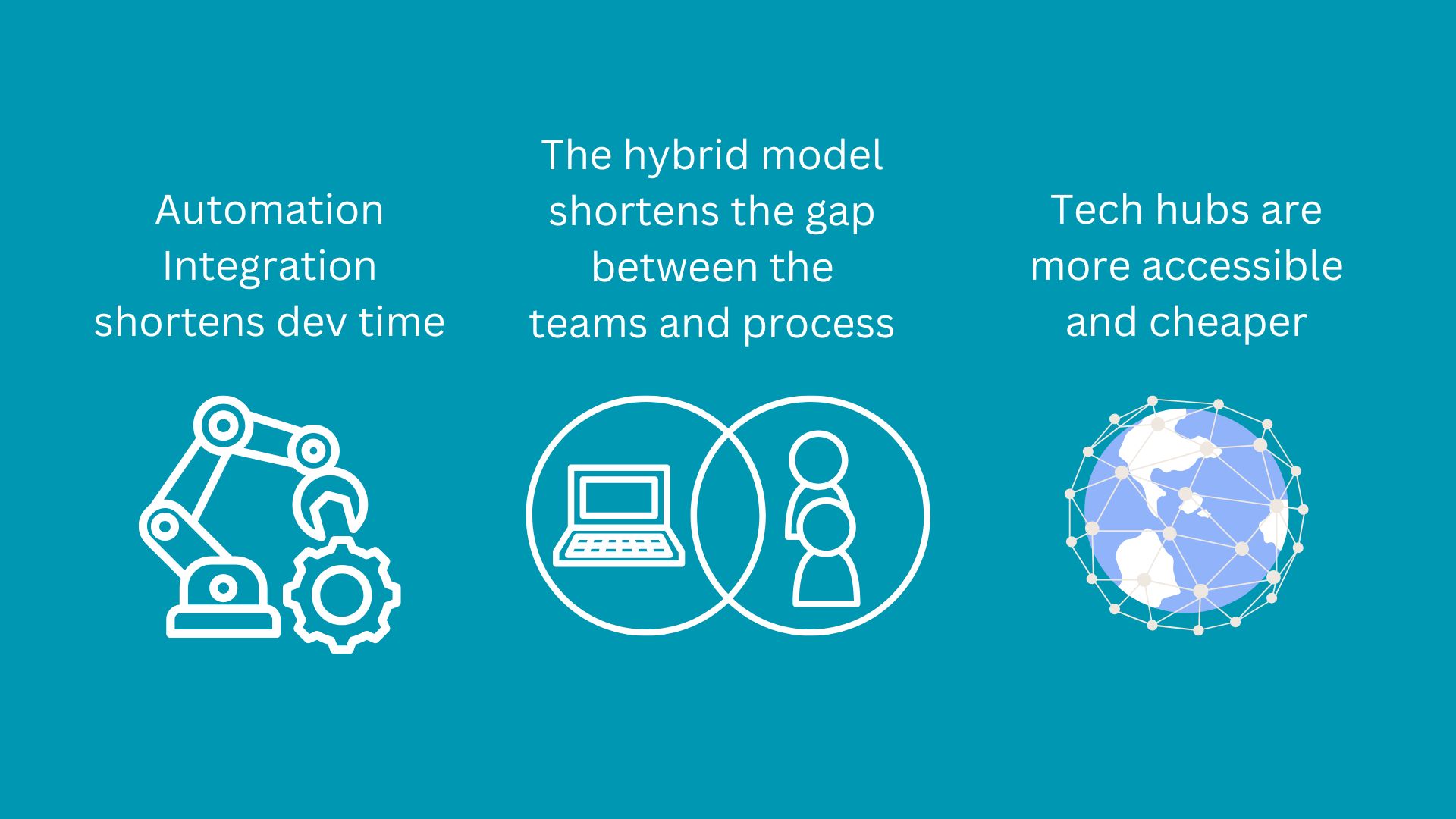
AI-enhanced development reduces time-to-market and improves productivity, resulting in lower development costs and faster delivery of the finished product.
Leading partners now use AI-Augmented Development (like GitHub Copilot or custom internal LLMs) to write boilerplate code more than 30% faster.
Placing your bet on an offshore agency that leverages AI tools might pay well.
B) Hybrid Team Models
Many companies are moving toward "Bridge Models," where a local Project Manager/Architect manages a larger offshore execution team to bridge the cultural and time-zone gap.
This model blends the strengths of both worlds: maintaining close control, cultural alignment, and quick communication through local teams while leveraging the cost advantages, specialized skills, and scalability of offshore talent.
How It's Used in Offshore Teams
This model is commonly used in industries such as software development, IT services, finance, and accounting. For example:
- In app development, an onshore project manager might oversee requirements and feedback, while an offshore team handles coding and testing.
- Companies like Amazon use hybrid setups, combining on-site teams for core functions with offshore groups for technical expertise and nearshore teams for customer support.
- It's ideal for scaling without full outsourcing, allowing businesses to start with a small offshore extension and expand as needed.
C) Rising Tech Hubs
New ecosystems are growing in Eastern Europe (Poland, Romania), Southeast Asia (Nepal), and Latin America (Mexico, Brazil).
Here, companies can expect a huge pool of AI-specialized talent, 24/7 cycles, perfect US time-zone alignment, and elite architecture.
Cities such as Bangalore, Warsaw, and Ho Chi Minh City are expanding rapidly due to skilled engineering talent and stable digital infrastructure.
Bottom Line
Choosing the right offshore app development partner in 2026 requires a balance of technical scrutiny and cultural intuition.
By defining your scope clearly, vetting for specialized expertise, and running a pilot sprint, you mitigate risk and set the stage for a high-velocity partnership.
Turn your concept into a market-ready product with Searchable Design, an offshoring app development agency that prioritizes quality, transparency, and cost-efficient development.
Comments(0)
Your email address will not be published. Required fields are marked *
Recommended Posts
Unlock the Secret of Power BI to Empower Your Data Analysis
Turn Raw Data into Real-Time Intelligence with Power BI
Why More Startups Are Offshoring Data Engineering Roles in 2026
Unlocking Global Talent for Faster, Smarter, Scalable Growth through Offshoring Data Engineering
How to Empower Your Web Development Project in 2025?
Empowering Your Web Build with the Right Strategy, Stack, and Global Talent Network
RECOMMENDED TOPICS
TAGS
- offshoring
- outsourcing
- remote team
- artificial intelligence
- nepal
- web development
- bot model
- data analytics
- digital marketing
- it support
- business process automation
- offshore
- bot
- legacy software
- saas
- app development
- development
- remote engineering
- recommender engine
- ai engine
- cybersecurity
- growth hack
- tiktok
- seo
- voice search optimization
- engineering team
- sprint planning
- modular app
- cloud based
- api based
- data entry
- api workflow
- service level agreements
- data warehouse
- database
- cloud storage
- engineering
- scalability
- remote engineers
- insurtech
- global talent pool
- techical consulting
- power bi
- business intelligence
- backoffice
- communication
- outsource
- it roles
- data engineering
- data engineer
- content development
- business development
- offshore talent
- agentic ai
- insurance
- web security
- project management
- pms
- project management system
- agile methodology
- data
- data centric approach
- customer insight
- it infrastructure
- it sustainability
- cloud computing
- data decision
- off
- test
About
Data Not Found
NEWSLETTER
Related Posts

Rise of Low-code, No-code: Democratizing Web Development for the Non-Techs
Turning business ideas into applications without writing code